HIGHLIGHTS
- Publishes evidence on public expectations regarding crisis communication and early warning.
- Highlights the importance of shelters, evacuation routes and long-term water management.
- Analyses PM2.5 risk areas and promotes knowledge to support the monitoring of health impacts among young children.
- Develops air quality measurement and monitoring activities, with publicly accessible reports.
Responding to flooding and environmental risks requires situational data, an understanding of public needs, and actionable communication. In 2025, Suan Dusit University undertook public opinion research, risk analysis and health-related monitoring through Suan Dusit Poll, the Environmental Centre, and the Environmental Health and Public Disaster programme. Survey findings, progress reports and activity news were published to provide access for relevant agencies and interested stakeholders.
Identifying Public Expectations for Early Warning and Flood Preparedness
Suan Dusit Poll conducted a nationwide survey entitled “Thai People and News Consumption during Crises” on 24–25 July 2025, involving 1,148 respondents. The findings were released on 27 July 2025.
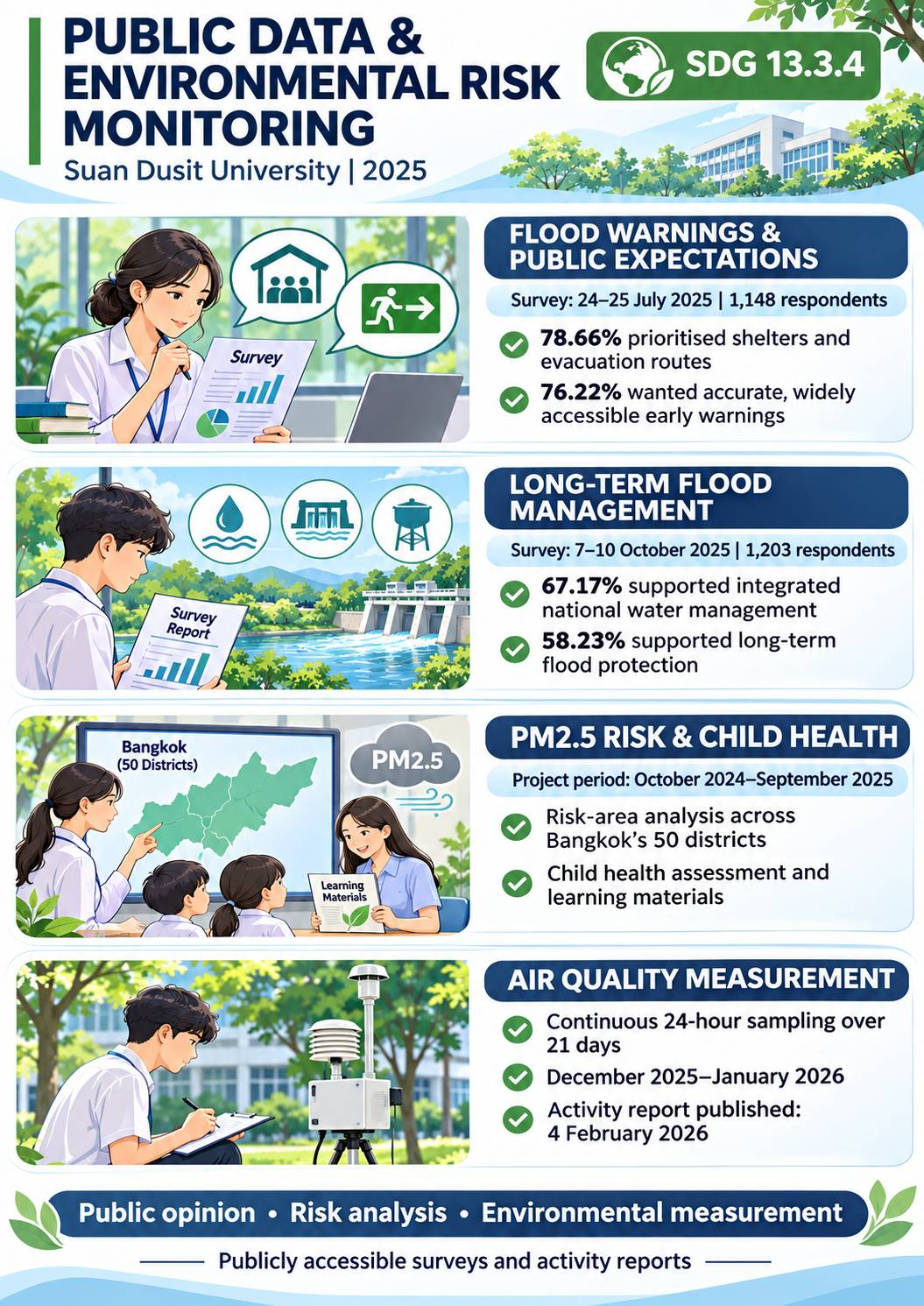
The survey found that 81.10% of respondents wanted government agencies and the media to communicate accurate information promptly and continuously, while 72.56% wanted clear guidance on appropriate actions. Regarding flooding, 78.66% prioritised the preparation of shelters and evacuation routes, and 76.22% called for accurate and widely accessible early warnings.
These findings indicate public demand for warning messages linked to practical preparedness, including guidance on evacuation and access to safe locations. They provide information that relevant agencies can consider when developing risk communication and emergency services.
https://dusitpoll.dusit.ac.th/UPLOAD_FILES/POLL/2568/PS-2568-1758186763.pdf
Publishing Public Perspectives on Water Management and Long-Term Risk Reduction
The survey “Handout-Based Economic Policies: Effective Support or Temporary Relief?” collected responses from 1,203 people on 7–10 October 2025, with findings released on 12 October 2025. It included questions on resource allocation to address environmental problems and flooding.
Regarding flood management, 67.17% of respondents supported an integrated national water management plan, 58.23% supported investment in long-term flood protection infrastructure, and 54.05% prioritised livelihood and economic recovery after floodwaters receded.
The findings contribute public perspectives on prevention and recovery alongside immediate assistance. Their publication makes this information available to agencies and other stakeholders considering approaches to flood management.
https://dusitpoll.dusit.ac.th/UPLOAD_FILES/POLL/2568/PS-2568-1760247161.pdf
Analysing Risk Areas and Monitoring PM2.5 Health Impacts among Young Children
In the field of environmental risk, the Environmental Centre, Faculty of Science and Technology, implemented a project to promote literacy for monitoring PM2.5 conditions and associated health impacts among young children in Bangkok. The project ran from 1 October 2024 to 30 September 2025.
The university’s progress report identifies three components: analysing PM2.5 risk areas across Bangkok’s 50 districts; assessing health impacts among children using La-orutis Demonstration School as the study setting; and developing educational materials for children, teachers and parents.
The project connects environmental risk analysis with assessment of impacts on a vulnerable population and communication to support protective practices. Its implementation is documented in a publicly accessible university progress report.
https://planning.dusit.ac.th/main/wp-content/uploads/2025/09/actionreport68-9month-1.pdf
Developing Continuous Air Quality Measurement and Monitoring
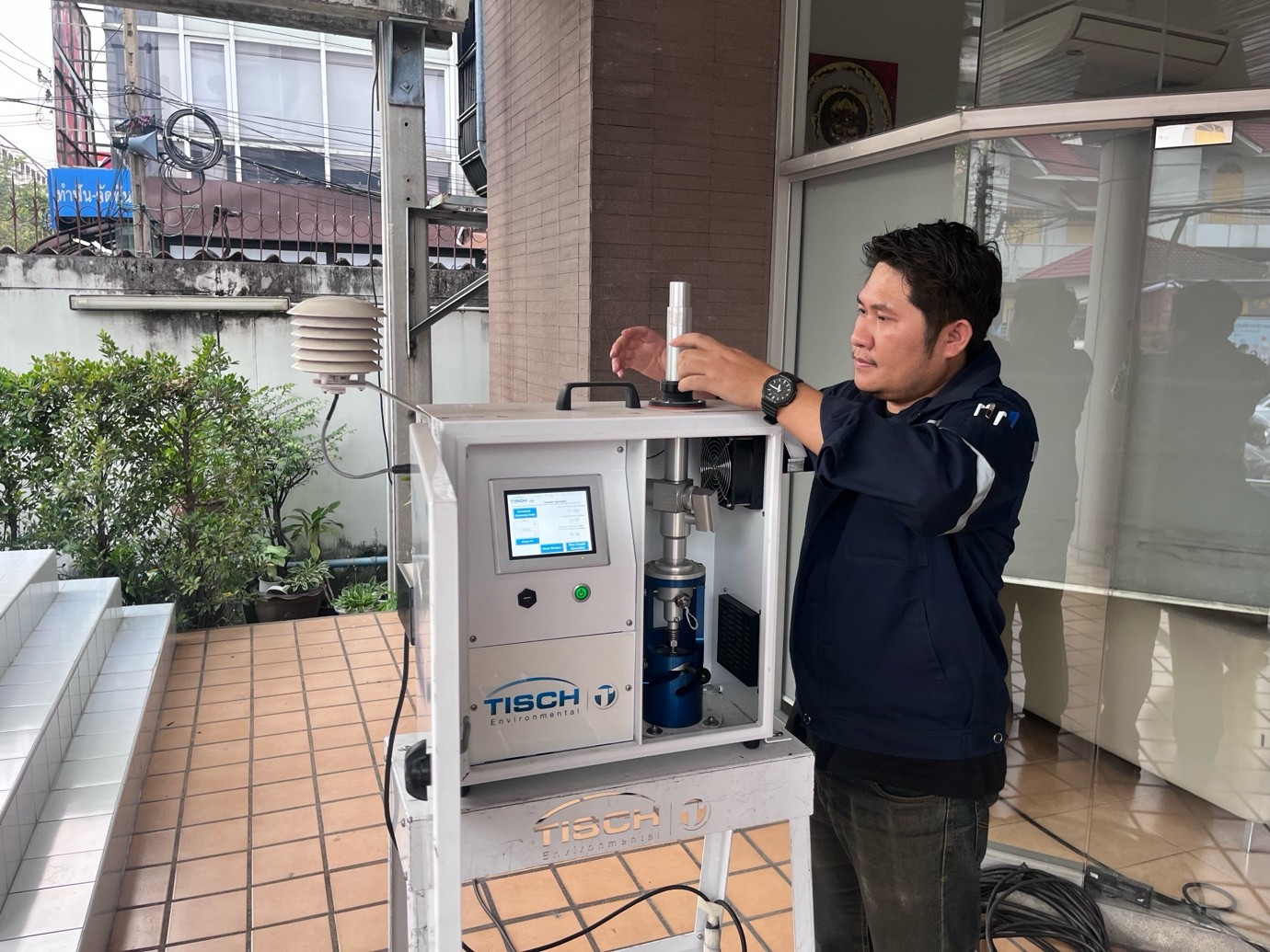
The Environmental Health and Public Disaster programme, Faculty of Science and Technology, conducted an integrated research project involving PM2.5 measurement and monitoring. Low-volume PM2.5 air samplers were installed at the Dr Siroj Pholphanthin Building, Suan Dusit University.
Continuous 24-hour sampling was undertaken over 21 days between December 2025 and January 2026. The activity report states that the resulting data would be used to support health-related alerts and surveillance, as well as teaching and practical training in environmental measurement, analysis and monitoring.
The activity began in late 2025 and continued into 2026. Its report was published on 4 February 2026 and therefore provides retrospective documentation of work spanning both years.
https://www.dusit.ac.th/home/2026/1856947.html
Providing Public Access to Information for Risk Communication and Management
These activities demonstrate Suan Dusit University’s contribution to producing complementary forms of information: public perspectives on flood warnings and preparedness, environmental risk analysis, and air quality measurements.
Publishing survey findings, progress reports and activity news enables agencies and interested stakeholders to access knowledge concerning public needs and environmental risks. This information provides a basis for knowledge exchange and the development of risk communication that considers local contexts and population needs.