
HIGHLIGHTS
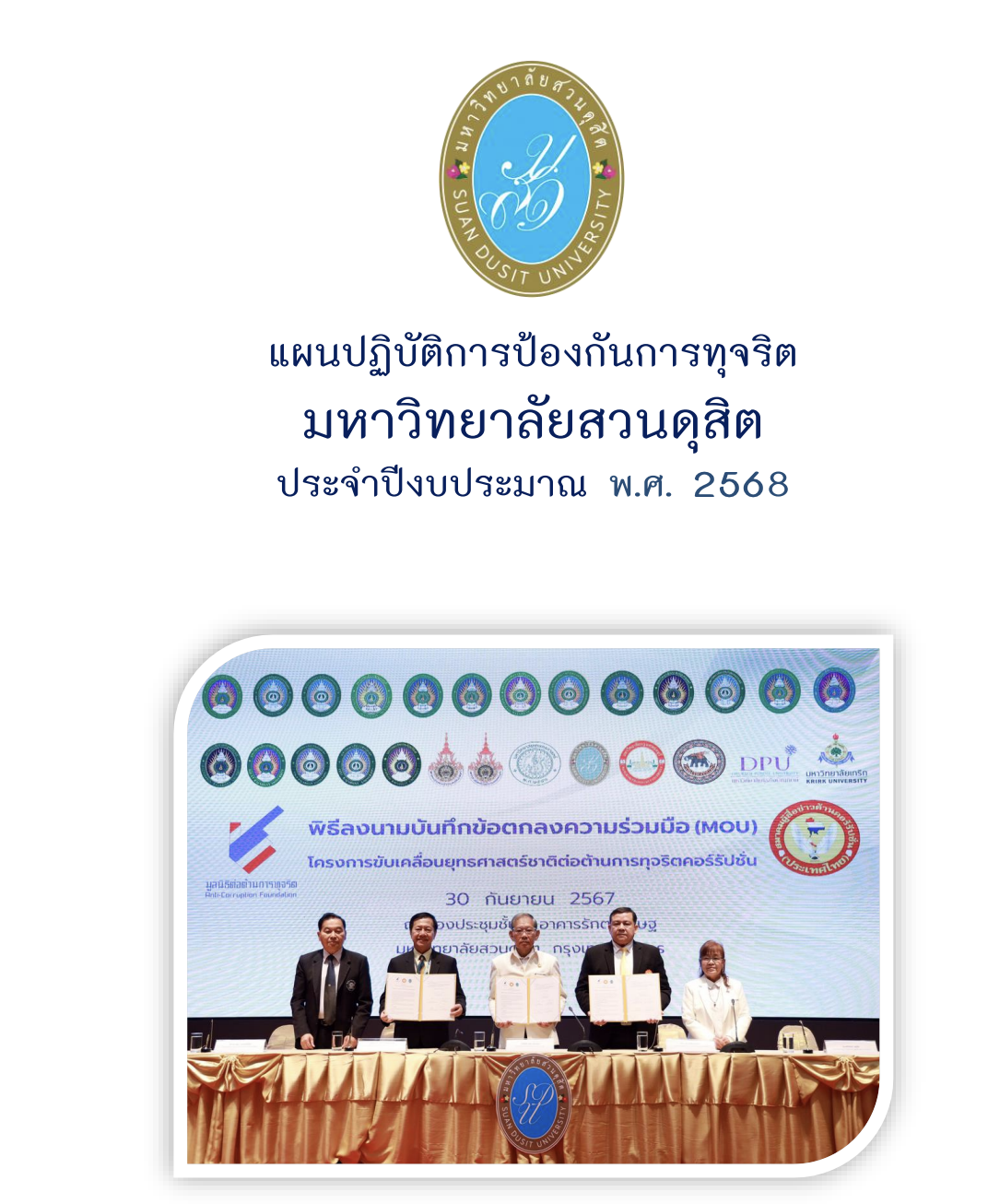
- Published anti-corruption framework: Suan Dusit University (SDU) published its Anti-Corruption Action Plan for Fiscal Year 2025, setting institutional directions to prevent corruption and strengthen integrity, ethics, transparency and good governance.
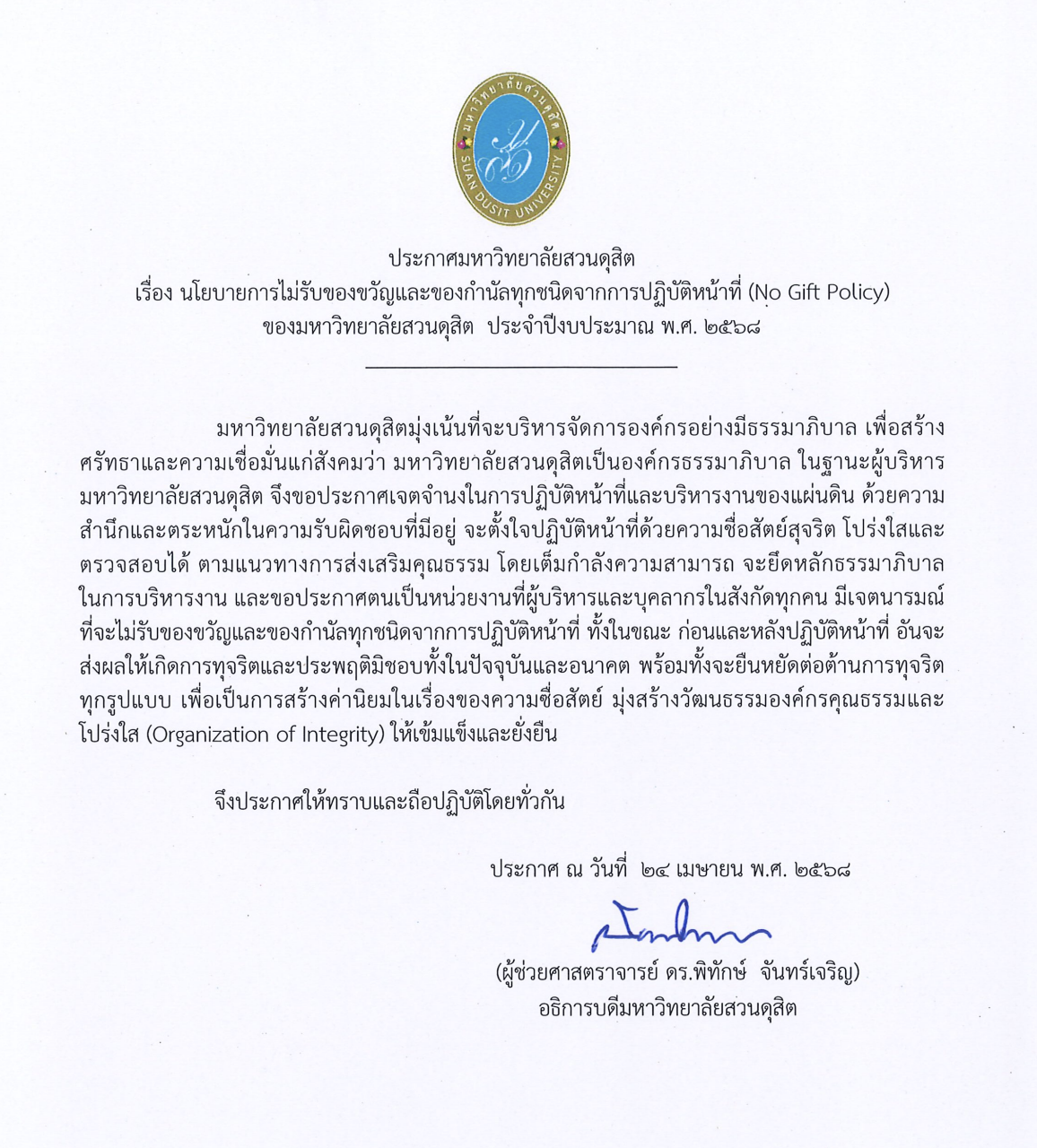
- No Gift Policy: On 24 April 2025, Assistant Professor Dr Pitak Chancharoen, President of SDU, issued the University’s No Gift Policy, committing all personnel not to accept gifts or benefits arising from official duties.
- Bribery-risk controls: SDU’s 2025 bribery-risk assessment covers four operational areas: legal authority or service delivery, procurement, human-resource management, and approval or licensing functions.
- Accessible reporting mechanism: SDU publicly provides corruption and misconduct complaint procedures, including an online reporting channel and a process for acknowledging and managing complaints.
Corruption and bribery undermine trust in public institutions, divert resources from education and public benefit, and weaken equitable decision-making. Suan Dusit University therefore establishes its integrity commitments through an institutional framework that links prevention, risk assessment, ethical conduct, public disclosure and accessible complaint handling. This framework is implemented under the Anti-Corruption Action Plan of Suan Dusit University for Fiscal Year 2025 and is aligned with SDU Goal 2568–2571, particularly its “Power of Management” direction for transparent and accountable administration.
The 2025 plan identifies corruption prevention as an institutional responsibility for executives, academic staff, support staff, students and relevant stakeholders. It establishes three strategic directions: building awareness and values based on good governance; integrating internal and external cooperation to prevent and oppose corruption; and improving the University’s Integrity and Transparency Assessment (ITA) performance. The Governance and Ethics Committee is assigned a central role in setting governance and ethical principles, maintaining ethics mechanisms, evaluating integrity and transparency, and submitting reviewed findings to the University Council.
A Clear Institutional Commitment against Gifts, Corruption and Undue Benefits
SDU’s formal No Gift Policy for Fiscal Year 2025 was signed by Assistant Professor Dr Pitak Chancharoen on 24 April 2025. The declaration commits the University, its executives and all personnel not to accept gifts or gratuities of any kind connected to the performance of official duties, whether before, during or after those duties. It frames this commitment as a preventive measure against corruption and misconduct and as part of building an “Organisation of Integrity.”
The policy is reinforced through the Anti-Corruption Action Plan 2025. The plan provides for an institutional activity on building a No Gift culture, with the stated objective that executives, academic staff and support staff understand and reject gifts and gratuities associated with their duties. It sets a participation target of 100% of the relevant personnel across University units during the fiscal-year implementation period from October 2024 to September 2025.
This combination of a signed policy statement and an implementation activity changes the University’s approach from a general expectation of ethical behaviour to a documented commitment with a designated operational mechanism. The policy was issued by the President, while the action plan assigns responsibility to the School of Law and Politics and the University Office, enabling the commitment to be communicated across the institution.
Managing Bribery Risks and Enabling Public Accountability
SDU published a Bribery Risk Assessment for Fiscal Year 2025 to identify and control risks that may arise from its operational duties. The assessment considers four relevant areas: approval or licensing; the exercise of legal authority or service delivery; procurement; and human-resource management. It notes that SDU has no approval or licensing function under the relevant Thai facilitation legislation, while still assessing risks in the other operational areas.
The assessment applies a risk-management process that includes identifying risks, analysing and evaluating them, selecting risk responses, establishing control activities and monitoring outcomes. It describes preventive, detective, directive and corrective controls. By making these processes explicit, SDU demonstrates that bribery prevention is not limited to a declaration of values: it is connected to operational review, internal controls and accountability in areas where conflicts of interest or undue influence may arise.
SDU also provides public procedures for reporting suspected corruption and misconduct. Members of the public and stakeholders may submit concerns in person, by post, telephone, Facebook or through the University’s online reporting channel. The published procedure identifies the responsible unit, requires initial receipt and review within one working day, and provides for complainants to receive a response within 15 days where a matter requires investigation or fact-finding. This mechanism supports transparency by allowing concerns relating to procurement, budget disbursement, project spending or other misconduct to be reported and managed through a defined process.
Extending Principles through Learning and Collaboration
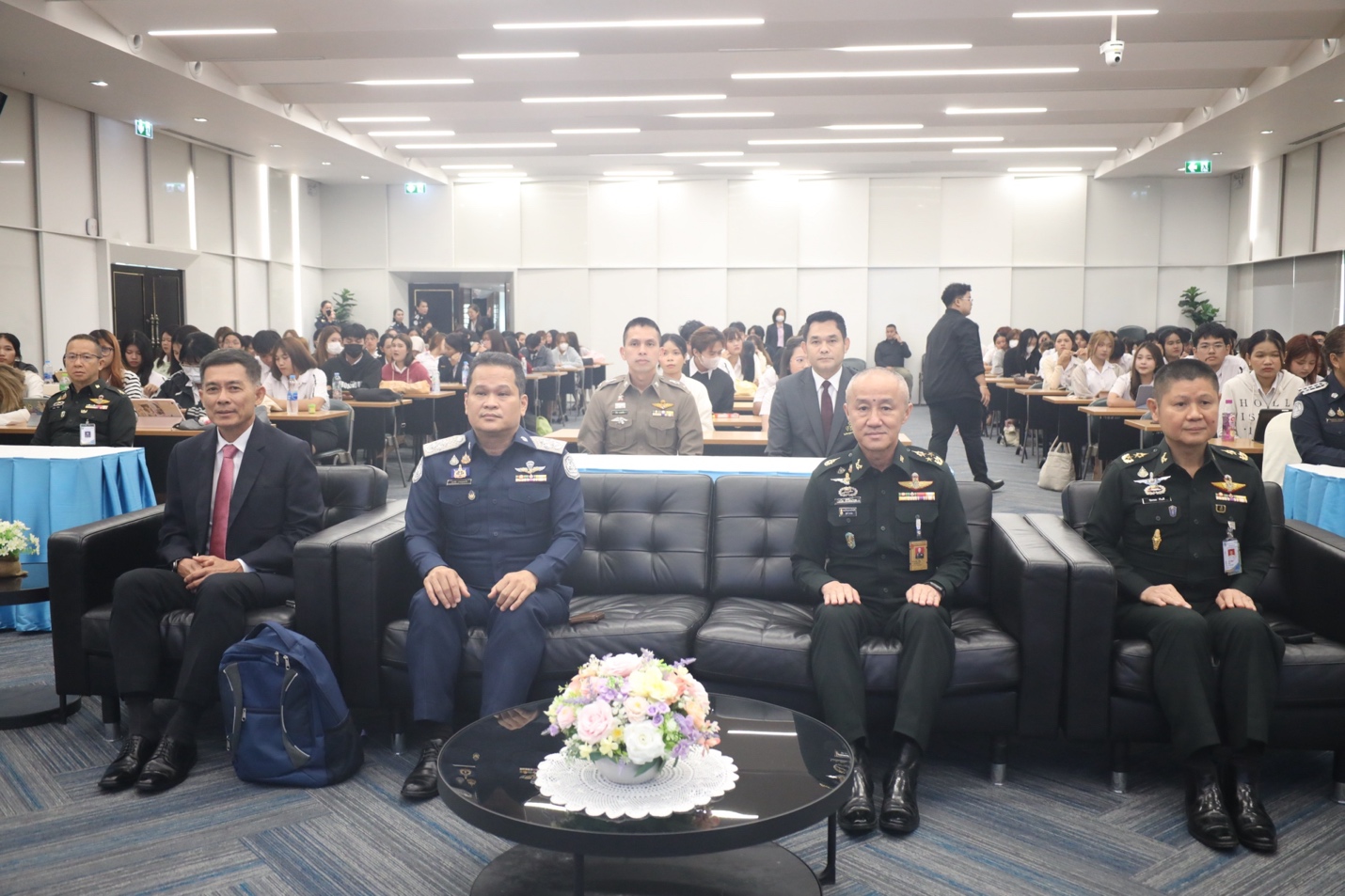
On 24 June 2025, SDU’s School of Law and Politics conducted a proactive anti-corruption surveillance programme with the Public Sector Anti-Corruption Commission, the Internal Security Operations Command and the Royal Police Cadet Academy. The public forum addressed the role and mission of the Public Sector Anti-Corruption Commission, youth participation in anti-corruption work, and mechanisms for building prevention and monitoring networks. The afternoon session used active-learning board games to support practical understanding of anti-corruption principles.
The event complements SDU’s published framework by translating institutional commitments into learning and public engagement. It involved national anti-corruption and public-security partners as well as University staff and participants, demonstrating that prevention requires awareness, practical knowledge and collaboration beyond administrative controls.

Together, SDU’s 2025 Anti-Corruption Action Plan, No Gift Policy, bribery-risk assessment and public complaint procedures provide published evidence of the University’s principles and commitments on corruption and bribery. The Governance and Ethics Committee, responsible University units and the University Council’s oversight processes provide continuity for implementation, monitoring and future review.
Public evidence links: Anti-Corruption Action Plan FY 2025, No Gift Policy FY 2025, Bribery Risk Assessment FY 2025, corruption complaint procedures, and anti-corruption surveillance programme, 24 June 2025. The activity’s partners, speakers and active-learning format are confirmed in SDU’s public news report.