
HIGHLIGHTS
- Statutory participatory body: Section 26 of the Suan Dusit University Act B.E. 2558 (2015) establishes the University Affairs Promotion Committee, whose chair and members are appointed by the University Council from persons external to the University.
- Direct route to the governing body: Under Section 19(2) of the Act, the Chair of the University Affairs Promotion Committee serves as an ex officio member of the University Council.
- Committee work reported to the Council: In 2025, the Committee considered its operational framework and meeting calendar, while the University Council received the Committee’s performance report on 28 November 2025.
- Participatory area-based planning: During 2025, SDU convened government, private-sector, community and local-knowledge representatives in Bangkok, Lampang, Suphan Buri and Trang to co-develop three-year area-based research priorities.
Suan Dusit University (SDU) provides meaningful mechanisms through which external stakeholders can contribute to University decision making. These mechanisms operate at two connected levels. At the governance level, the University Affairs Promotion Committee provides a formal route for persons external to the University to advise, support and connect with the University Council. At the operational level, area-based research forums enable local government, private-sector, community and local-knowledge representatives to participate in determining research priorities for the areas served by SDU.
This approach supports Sustainable Development Goal 16, particularly the principle of responsive, inclusive and participatory decision making. The University’s mechanisms go beyond one-way communication or occasional consultation. They create structured opportunities for external perspectives to be considered in institutional governance, research planning and community-development activities.
A Statutory Committee Linking External Perspectives with Governance
The Suan Dusit University Act B.E. 2558 (2015) establishes the University Affairs Promotion Committee in Section 26. The Act provides that the University Council appoints the Committee’s chair and members from persons external to the University. The Committee is mandated to promote and support the University, provide advice and consultation, support scholarships for students with financial need, and help generate income for the University.
The Committee therefore represents a formal institutional mechanism through which external expertise and perspectives can inform University affairs. Its role is not limited to attending events; it is established by law, appointed by the University Council and assigned advisory and support functions relevant to the University’s direction and development.
The Act further creates a direct connection between this external participatory mechanism and the University’s highest governing body. Section 19(2) provides that the Chair of the University Affairs Promotion Committee is an ex officio member of the University Council. This arrangement enables the Committee’s external perspective to reach the Council, which has authority to determine policy, approve development and operational plans, appoint committees, and oversee the University’s general affairs.
Committee Deliberation and Council Oversight in 2025
On 16 September 2025, the Office of the University Council Secretariat convened the first meeting of the University Affairs Promotion Committee for 2025. Mr. Kittisak Mapanao chaired the meeting. The agenda included consideration of the Committee’s operating framework, the establishment of its meeting calendar and participation in the 10th national seminar for university affairs promotion committees.
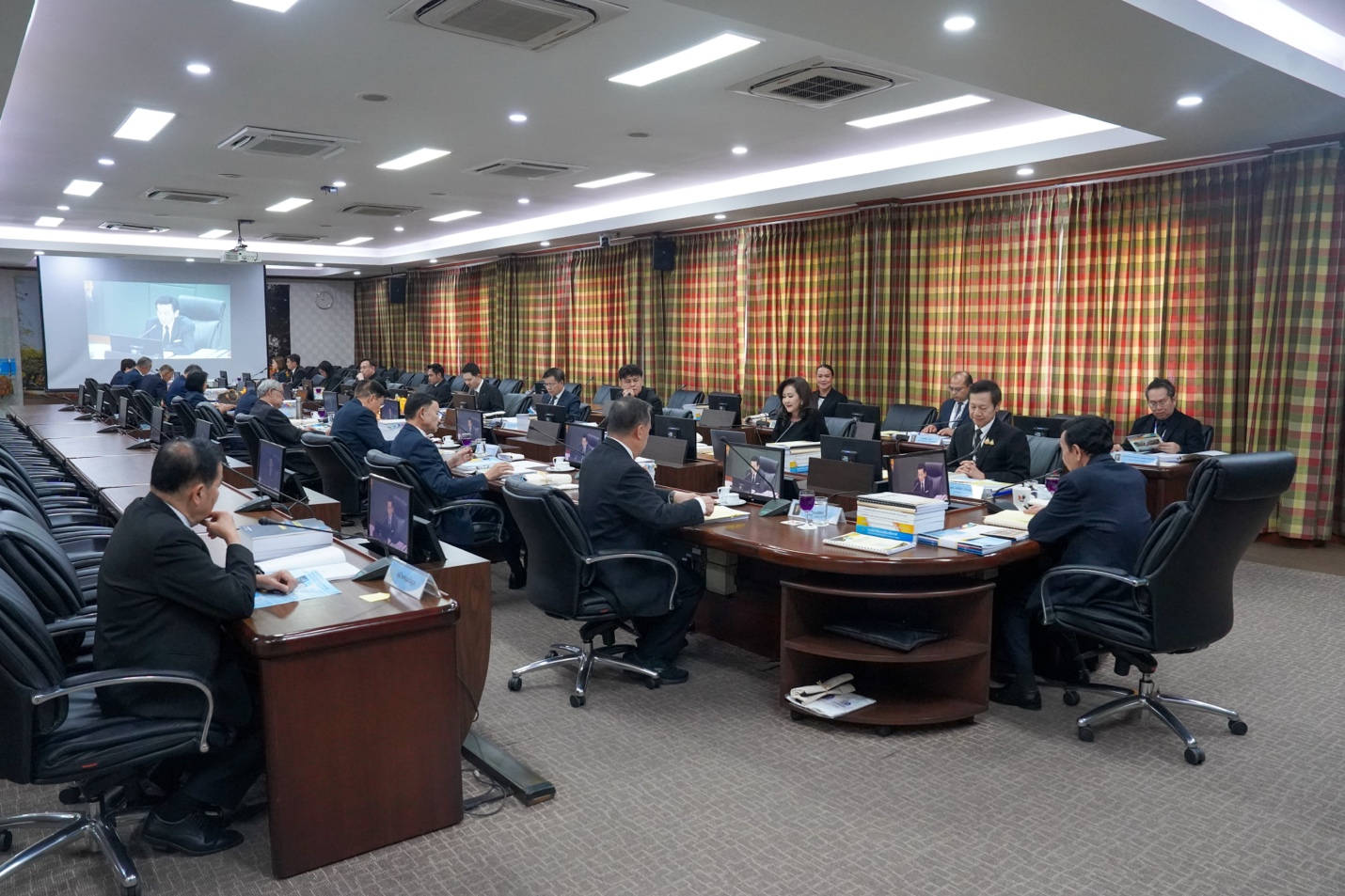
At the meeting, Assistant Professor Dr. Phithak Chancharoen, President of Suan Dusit University, presented the University’s policy direction and SDU GOAL 2025–2028: The Power of SDU. This enabled the external Committee to consider its role and planned work in relation to the University’s current strategic direction. The meeting created a documented mechanism for external members to engage with the University’s operational framework rather than serving only in a ceremonial capacity.
The Committee’s role was subsequently connected to University Council oversight. At the University Council Meeting No. 11(27)/2025 on 28 November 2025, the Council received the performance report of the University Affairs Promotion Committee. The November 2025 Council Newsletter further records that the Council provided observations and recommendations to the University for implementation. This demonstrates a feedback route from an external-member committee to the body responsible for University-level governance and decision making.
Area Based Research Forums as Participatory Decision Processes
SDU also used structured area-based research forums to involve local stakeholders in decisions on research and development priorities. The Research and Development Institute worked with SDU education centres and campuses to develop three-year research programmes based on the needs, challenges and strengths of each area.
On 22 April 2025, SDU Lampang Education Center convened representatives from government, private-sector and citizen sectors to contribute to Lampang’s three-year area-development research priorities. On 29 May 2025, the Research and Development Institute convened a comparable forum for Bangkok, involving government representatives, entrepreneurs, academics, community leaders and local wisdom holders. Participants used joint discussion and small-group sessions to identify local problems, needs and research questions.
The process continued at Suphan Buri Campus on 9 June 2025 and at Trang Education Center on 30 June 2025. Both forums brought together representatives from government, private-sector and citizen sectors to identify three-year development goals and generate research questions. In Trang, the consultation considered local food value creation, environmentally friendly value-based tourism, and processed agriculture and community enterprises based on the creative economy.
These forums constitute participatory mechanisms because local stakeholders contribute before research priorities are determined. Their inputs are not treated merely as event feedback; they are used to develop area-based research programmes and research questions, thereby informing decisions about the direction of SDU research and community-development work.
Sustaining Meaningful Participation
The University Affairs Promotion Committee provides the formal governance bridge between external stakeholders and the University Council. The area-based research forums complement this structure by ensuring that community representatives, public agencies and other local partners contribute directly to the definition of research priorities in the places where SDU operates.
Together, these mechanisms demonstrate that SDU provides meaningful opportunities for external stakeholders to participate in University decision making. The University will continue to use the Committee’s advisory role, Council reporting process and area-based research forums to integrate external perspectives into strategic direction, research planning and community development under SDU GOAL 2025–2028.
Public evidence links: University Affairs Promotion Committee meeting No. 1/2025, 16 September 2025, University Council meeting No. 11(27)/2025, 28 November 2025, University Council authority and functions under the Suan Dusit University Act B.E. 2558, Bangkok stakeholder consultation for area-based research priorities, and Trang stakeholder consultation for area-based research priorities. These sources demonstrate both a formal committee structure involving external persons and consultation mechanisms through which local government, business and community representatives contribute to University priorities.