
HIGHLIGHTS
- Formal policy in force: Suan Dusit University (SDU) issued the Announcement on the Exercise of Academic Freedom B.E. 2565 (2022) on 15 August 2022 under Section 32(1) of the Suan Dusit University Act B.E. 2558 (2015).
- All academic career stages covered: The policy expressly supports academic freedom for senior, mid-career and early-career academic staff.
- Research, teaching and public expression: SDU recognises academic freedom in learning, teaching, research, academic services and the expression of academic views.
- Protection from interference: The policy requires instructors to promote students’ academic freedom and to prevent coercion, misuse of authority or interference that restricts academic expression.
Academic freedom is fundamental to a university’s capacity to create knowledge, examine complex questions and contribute evidence-based perspectives to society. It enables academic staff to undertake research, develop teaching approaches and communicate academic viewpoints within their areas of expertise. At the same time, academic freedom must operate with integrity, respect for others, professional ethics and compliance with law.
Suan Dusit University has established a formal institution-wide framework through the Announcement on the Exercise of Academic Freedom B.E. 2565 (2022). Signed by Associate Professor Dr Siroj Pholpinit, President of Suan Dusit University, on 15 August 2022, the announcement is based on Section 32(1) of the Suan Dusit University Act B.E. 2558 (2015). It provides a clear policy basis for academic freedom in learning, teaching, research, academic services and the expression of academic opinions.
Recognising Research and Teaching Freedom across Academic Careers
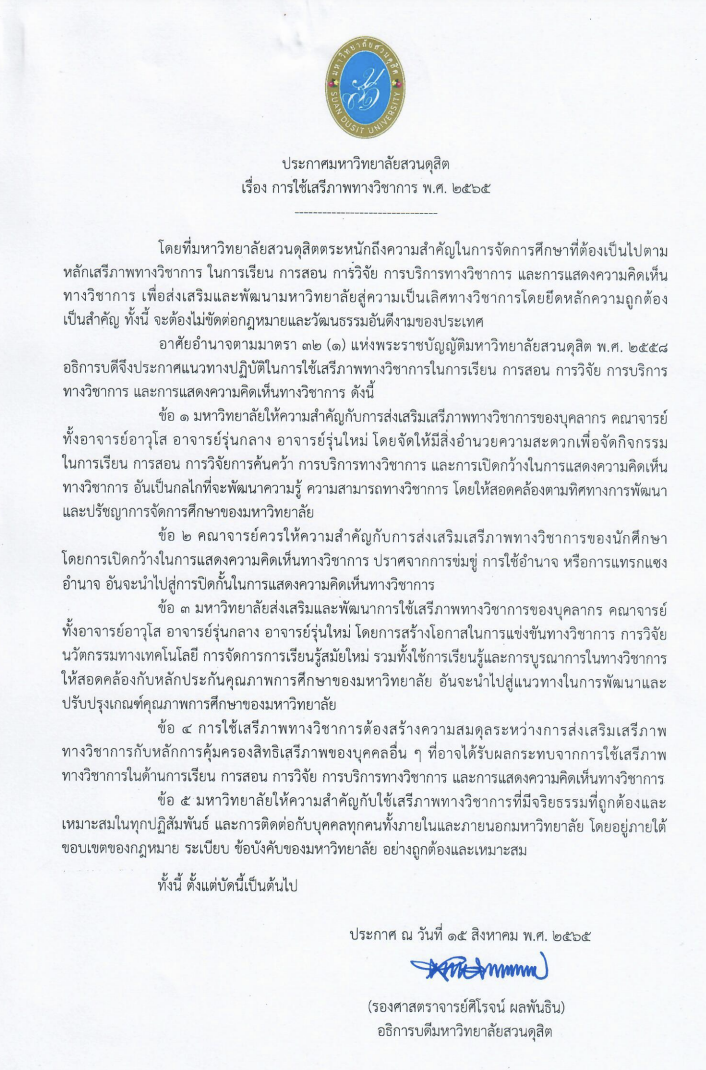
The policy states that SDU gives importance to promoting the academic freedom of its personnel and academic staff at all career stages, specifically including senior academics, mid-career academics and early-career academics. This explicit coverage is important because it ensures that opportunities for scholarly inquiry and teaching are not confined to senior staff or holders of particular academic titles.
The announcement supports academic freedom across five connected areas: learning, teaching, research and inquiry, academic services, and the open expression of academic opinions. SDU commits to providing appropriate enabling conditions for these activities, so that academic staff can develop their knowledge and academic capabilities in line with the University’s educational direction and philosophy.
For the purposes of SDG 16.2.6, the policy directly addresses all four groups assessed by Times Higher Education. It supports research freedom for senior, mid-career and early-career academic staff, as well as teaching freedom for the same groups. The policy’s express inclusion of research, teaching and academic expression also provides a foundation for staff to communicate publicly on matters within their scholarly expertise, subject to appropriate professional responsibilities.
Creating a Learning Environment Free from Coercion and Interference
SDU’s policy also recognises that academic freedom depends on the quality of relationships within the learning environment. It assigns academic staff a responsibility to promote students’ academic freedom by encouraging open academic expression and ensuring that students are free from coercion, misuse of power or interference that could obstruct their ability to express academic views.
This provision connects staff freedom with student learning. It establishes that teaching should not be limited to the transmission of prescribed information, but should create an environment in which questions, evidence, critical analysis and scholarly discussion can take place. The policy therefore supports an academic culture in which staff can design learning activities and students can participate in academic dialogue without improper pressure.
The announcement further requires SDU to promote and develop academic freedom through opportunities for academic competition, research, technological innovation, contemporary learning management and academic integration. These provisions support the practical conditions through which freedom can be exercised, including the pursuit of new ideas, research development and the communication of knowledge through teaching and academic services.
Exercising Freedom with Academic Integrity and Social Responsibility
The policy defines academic freedom as inseparable from truthfulness, ethics and responsibility. It requires that the exercise of freedom in learning, teaching, research, academic services and academic expression must not conflict with Thai law or the country’s moral and cultural values. It also requires a balance between academic freedom and the protection of the rights and freedoms of other persons who may be affected.
SDU further states that academic freedom must be exercised ethically and appropriately in all relationships and interactions with persons inside and outside the University. This includes observance of relevant laws, regulations and University rules. These safeguards do not remove academic freedom; rather, they establish a framework in which academic inquiry and public academic expression are undertaken responsibly, accurately and with respect for others.
The announcement has been publicly published through SDU’s legal-regulations database and the University’s SDG regulations page. Its date of issue, 15 August 2022, falls within THE’s required policy creation or review period of 2022–2026. The policy therefore provides direct public evidence that SDU supports academic freedom in research, teaching and academic expression for academic personnel across career stages.
Public evidence links: https://sdulaw.dusit.ac.th/app/files/regular/880 SDU legal regulations database, and SDU SDG regulations page. The announcement is publicly listed in both institutional repositories.